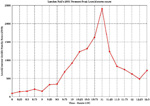
Landon Noll looking up Fremont Peak Observatory 0.8m telescope Leonid 2001 meteor squall count at Fremont Peak

Partial list of calc builtin functions

[chongo's home] [Astronomy] [Mathematics] [Prime Numbers] [Programming] [Technology] [contacting Landon]


Calc builtin functions (as of version 2.12.1.5)

Builtin functions

 There is a large number of built-in functions. Many of the
 functions work on several types of arguments, whereas some only
 work for the correct types (e.g., numbers or strings). In the
 following description, this is indicated by whether or not the
 description refers to values or numbers. This display is generated
 by the 'show builtin' command.

 Name Args Description

 abs 1-2 absolute value within accuracy b
 access 1-2 determine accessibility of file a for mode b
 acos 1-2 arccosine of a within accuracy b
 acosh 1-2 inverse hyperbolic cosine of a within accuracy b
 acot 1-2 arccotangent of a within accuracy b
 acoth 1-2 inverse hyperbolic cotangent of a within accuracy b
 acsc 1-2 arccosecant of a within accuracy b
 acsch 1-2 inverse csch of a within accuracy b
 agd 1-2 inverse gudermannian function
 append 1+ append values to end of list
 appr 1-3 approximate a by multiple of b using rounding c
 arg 1-2 argument (the angle) of complex number
 argv 0-1 calc argc or argv string
 asec 1-2 arcsecant of a within accuracy b
 asech 1-2 inverse hyperbolic secant of a within accuracy b
 asin 1-2 arcsine of a within accuracy b
 asinh 1-2 inverse hyperbolic sine of a within accuracy b
 assoc 0 create new association array
 atan 1-2 arctangent of a within accuracy b
 atan2 2-3 angle to point (b,a) within accuracy c
 atanh 1-2 inverse hyperbolic tangent of a within accuracy b
 avg 0+ arithmetic mean of values
 base 0-1 set default output base
 base2 0-1 set default secondary output base
 bernoulli 1 Bernoulli number for index a
 bit 2 whether bit b in value a is set
 blk 0-3 block with or without name, octet number, chunksize
 blkcpy 2-5 copy value to/from a block: blkcpy(d,s,len,di,si)
 blkfree 1 free all storage from a named block
 blocks 0-1 named block with specified index, or null value
 bround 1-3 round value a to b number of binary places
 btrunc 1-2 truncate a to b number of binary places
 calc_tty 0 set tty for interactivity
 calclevel 0 current calculation level
 calcpath 0 current CALCPATH search path value
 catalan 1 catalan number for index a
 ceil 1 smallest integer greater than or equal to number
 cfappr 1-3 approximate a within accuracy b using
    continued fractions
 cfsim 1-2 simplify number using continued fractions
 char 1 character corresponding to integer value
 cmdbuf 0 command buffer
 cmp 2 compare values returning -1, 0, or 1
 comb 2 combinatorial number a!/b!(a-b)!
 config 1-2 set or read configuration value
 conj 1 complex conjugate of value
 copy 2-5 copy value to/from a block: copy(s,d,len,si,di)
 cos 1-2 cosine of value a within accuracy b
 cosh 1-2 hyperbolic cosine of a within accuracy b
 cot 1-2 cotangent of a within accuracy b
 coth 1-2 hyperbolic cotangent of a within accuracy b
 count 2 count listr/matrix elements satisfying some condition
 cp 2 cross product of two vectors
 csc 1-2 cosecant of a within accuracy b
 csch 1-2 hyperbolic cosecant of a within accuracy b
 ctime 0 date and time as string
 custom 0+ custom builtin function interface
 delete 2 delete element from list a at position b
 den 1 denominator of fraction
 det 1 determinant of matrix
 digit 2-3 digit at specified decimal place of number
 digits 1-2 number of digits in base b representation of a
 display 0-1 number of decimal digits for displaying numbers
 dp 2 dot product of two vectors
 epsilon 0-1 set or read allowed error for real calculations
 errcount 0-1 set or read error count
 errmax 0-1 set or read maximum for error count
 errno 0-1 set or read calc_errno
 error 0-1 generate error value
 estr 1 exact text string representation of value
 euler 1 Euler number
 eval 1 evaluate expression from string to value
 exp 1-2 exponential of value a within accuracy b
 factor 1-3 lowest prime factor < b of a, return c if error
 fcnt 2 count of times one number divides another
 fib 1 Fibonacci number F(n)
 forall 2 do function for all elements of list or matrix
 frem 2 number with all occurrences of factor removed
 fact 1 factorial
 fclose 0+ close file
 feof 1 whether EOF reached for file
 ferror 1 whether error occurred for file
 fflush 0+ flush output to file(s)
 fgetc 1 read next char from file
 fgetfield 1 read next white-space delimited field from file
 fgetfile 1 read to end of file
 fgetline 1 read next line from file, newline removed
 fgets 1 read next line from file, newline is kept
 fgetstr 1 read next null-terminated string from file, null
    character is kept
 files 0-1 return opened file or max number of opened files
 floor 1 greatest integer less than or equal to number
 fopen 2 open file name a in mode b
 fpathopen 2-3 open file name a in mode b, search for a along
    CALCPATH or path c
 fprintf 2+ print formatted output to opened file
 fputc 2 write a character to a file
 fputs 2+ write one or more strings to a file
 fputstr 2+ write one or more null-terminated strings to a file
 free 0+ free listed or all global variables
 freebernoulli 0 free stored Bernoulli numbers
 freeeuler 0 free stored Euler numbers
 freeglobals 0 free all global and visible static variables
 freeredc 0 free redc data cache
 freestatics 0 free all unscoped static variables
 freopen 2-3 reopen a file stream to a named file
 fscan 2+ scan a file for assignments to one or
    more variables
 fscanf 2+ formatted scan of a file for assignment to one
    or more variables
 fseek 2-3 seek to position b (offset from c) in file a
 fsize 1 return the size of the file
 ftell 1 return the file position
 frac 1 fractional part of value
 gcd 1+ greatest common divisor
 gcdrem 2 a divided repeatedly by gcd with b
 gd 1-2 gudermannian function
 getenv 1 value of environment variable (or NULL)
 hash 1+ return non-negative hash value for one or
    more values
 head 2 return list of specified number at head of a list
 highbit 1 high bit number in base 2 representation
 hmean 0+ harmonic mean of values
 hnrmod 4 v mod h*2^n+r, h>0, n>0, r = -1, 0 or 1
 hypot 2-3 hypotenuse of right triangle within accuracy c
 ilog 2 integral log of a to integral base b
 ilog10 1 integral log of a number base 10
 ilog2 1 integral log of a number base 2
 im 1 imaginary part of complex number
 indices 2 indices of a specified assoc or mat value
 inputlevel 0 current input depth
 insert 2+ insert values c ... into list a at position b
 int 1 integer part of value
 inverse 1 multiplicative inverse of value
 iroot 2 integer b'th root of a
 isassoc 1 whether a value is an association
 isatty 1 whether a file is a tty
 isblk 1 whether a value is a block
 isconfig 1 whether a value is a config state
 isdefined 1 whether a string names a function
 iserror 1 where a value is an error
 iseven 1 whether a value is an even integer
 isfile 1 whether a value is a file
 ishash 1 whether a value is a hash state
 isident 1 returns 1 if identity matrix
 isint 1 whether a value is an integer
 islist 1 whether a value is a list
 ismat 1 whether a value is a matrix
 ismult 2 whether a is a multiple of b
 isnull 1 whether a value is the null value
 isnum 1 whether a value is a number
 isobj 1 whether a value is an object
 isobjtype 1 whether a string names an object type
 isodd 1 whether a value is an odd integer
 isoctet 1 whether a value is an octet
 isprime 1-2 whether a is a small prime, return b if error
 isptr 1 whether a value is a pointer
 isqrt 1 integer part of square root
 isrand 1 whether a value is a additive 55 state
 israndom 1 whether a value is a Blum state
 isreal 1 whether a value is a real number
 isrel 2 whether two numbers are relatively prime
 isstr 1 whether a value is a string
 issimple 1 whether value is a simple type
 issq 1 whether or not number is a square
 istype 2 whether the type of a is same as the type of b
 jacobi 2 -1 => a is not quadratic residue mod b
    1 => b is composite, or a is quad residue of b
 join 1+ join one or more lists into one list
 lcm 1+ least common multiple
 lcmfact 1 lcm of all integers up till number
 lfactor 2 lowest prime factor of a in first b primes
 links 1 links to number or string value
 list 0+ create list of specified values
 ln 1-2 natural logarithm of value a within accuracy b
 log 1-2 base 10 logarithm of value a within accuracy b
 lowbit 1 low bit number in base 2 representation
 ltol 1-2 leg-to-leg of unit right triangle (sqrt(1 - a^2))
 makelist 1 create a list with a null elements
 matdim 1 number of dimensions of matrix
 matfill 2-3 fill matrix with value b (value c on diagonal)
 matmax 2 maximum index of matrix a dim b
 matmin 2 minimum index of matrix a dim b
 matsum 1 sum the numeric values in a matrix
 mattrace 1 return the trace of a square matrix
 mattrans 1 transpose of matrix
 max 0+ maximum value
 md5 0+ MD5 Hash Algorithm
 memsize 1 number of octets used by the value, including overhead
 meq 3 whether a and b are equal modulo c
 min 0+ minimum value
 minv 2 inverse of a modulo b
 mmin 2 a mod b value with smallest abs value
 mne 3 whether a and b are not equal modulo c
 mod 2-3 residue of a modulo b, rounding type c
 modify 2 modify elements of a list or matrix
 name 1 name assigned to block or file
 near 2-3 sign of (abs(a-b) - c)
 newerror 0-1 create new error type with message a
 nextcand 1-5 smallest value == d mod e > a, ptest(a,b,c) true
 nextprime 1-2 return next small prime, return b if err
 norm 1 norm of a value (square of absolute value)
 null 0+ null value
 num 1 numerator of fraction
 ord 1 integer corresponding to character value
 param 1 value of parameter n (or parameter count if n
    is zero)
 perm 2 permutation number a!/(a-b)!
 prevcand 1-5 largest value == d mod e < a, ptest(a,b,c) true
 prevprime 1-2 return previous small prime, return b if err
 pfact 1 product of primes up till number
 pi 0-1 value of pi accurate to within epsilon
 pix 1-2 number of primes <= a < 2^32, return b if error
 places 1-2 places after "decimal" point (-1 if infinite)
 pmod 3 mod of a power (a ^ b (mod c))
 polar 2-3 complex value of polar coordinate (a * exp(b*1i))
 poly 1+ evaluates a polynomial given its coefficients
    or coefficient-list
 pop 1 pop value from front of list
 popcnt 1-2 number of bits in a that match b (or 1)
 power 2-3 value a raised to the power b within accuracy c
 protect 1-3 read or set protection level for variable
 ptest 1-3 probabilistic primality test
 printf 1+ print formatted output to stdout
 prompt 1 prompt for input line using value a
 push 1+ push values onto front of list
 putenv 1-2 define an environment variable
 quo 2-3 integer quotient of a by b, rounding type c
 quomod 4-5 set c and d to quotient and remainder of a
    divided by b
 rand 0-2 additive 55 random number [0,2^64), [0,a), or [a,b)
 randbit 0-1 additive 55 random number [0,2^a)
 random 0-2 Blum-Blum-Shub random number [0,2^64), [0,a), or [a,b)
 randombit 0-1 Blum-Blum-Sub random number [0,2^a)
 randperm 1 random permutation of a list or matrix
 rcin 2 convert normal number a to REDC number mod b
 rcmul 3 multiply REDC numbers a and b mod c
 rcout 2 convert REDC number a mod b to normal number
 rcpow 3 raise REDC number a to power b mod c
 rcsq 2 square REDC number a mod b
 re 1 real part of complex number
 remove 1 remove value from end of list
 reverse 1 reverse a copy of a matrix or list
 rewind 0+ rewind file(s)
 rm 1+ remove file(s), -f turns off no-such-file errors
 root 2-3 value a taken to the b'th root within accuracy c
 round 1-3 round value a to b number of decimal places
 rsearch 2-4 reverse search matrix or list for value b
    starting at index c
 runtime 0 user mode cpu time in seconds
 saveval 1 set flag for saving values
 scale 2 scale value up or down by a power of two
 scan 1+ scan standard input for assignment to one
    or more variables
 scanf 2+ formatted scan of standard input for assignment
    to variables
 search 2-4 search matrix or list for value b starting
    at index c
 sec 1-2 sec of a within accuracy b
 sech 1-2 hyperbolic secant of a within accuracy b
 seed 0 return a 64 bit seed for a psuedo-random generator
 segment 2-3 specified segment of specified list
 select 2 form sublist of selected elements from list
 setbit 2-3 set specified bit in string
 sgn 1 sign of value (-1, 0, 1)
 sha 0+ old Secure Hash Algorithm (SHS FIPS Pub 180)
 sha1 0+ Secure Hash Algorithm (SHS-1 FIPS Pub 180-1)
 sin 1-2 sine of value a within accuracy b
 sinh 1-2 hyperbolic sine of a within accuracy b
 size 1 total number of elements in value
 sizeof 1 number of octets used to hold the value
 sleep 0-1 suspend operation for a seconds
 sort 1 sort a copy of a matrix or list
 sqrt 1-3 square root of value a within accuracy b
 srand 0-1 seed the rand() function
 srandom 0-4 seed the random() function
 ssq 1+ sum of squares of values
 stoponerror 0-1 assign value to stoponerror flag
 str 1 simple value converted to string
 strcat 1+ concatenate strings together
 strcmp 2 compare two strings
 strcpy 2 copy string to string
 strerror 0-1 string describing error type
 strlen 1 length of string
 strncmp 3 compare strings a, b to c characters
 strncpy 3 copy up to c characters from string to string
 strpos 2 index of first occurrence of b in a
 strprintf 1+ return formatted output as a string
 strscan 2+ scan a string for assignments to one or more variables
 strscanf 2+ formatted scan of string for assignments to variables
 substr 3 substring of a from position b for c chars
 sum 0+ sum of list or object sums and/or other terms
 swap 2 swap values of variables a and b (can be dangerous)
 system 1 call Unix command
 tail 2 retain list of specified number at tail of list
 tan 1-2 tangent of a within accuracy b
 tanh 1-2 hyperbolic tangent of a within accuracy b
 test 1 test that value is nonzero
 time 0 number of seconds since 00:00:00 1 Jan 1970 UTC
 trunc 1-2 truncate a to b number of decimal places
 ungetc 2 unget char read from file
 version 0 calc version string
 xor 1+ logical xor


 The config function sets or reads the value of a configuration
 parameter. The first argument is a string which names the parameter
 to be set or read. If only one argument is given, then the current
 value of the named parameter is returned. If two arguments are given,
 then the named parameter is set to the value of the second argument,
 and the old value of the parameter is returned. Therefore you can
 change a parameter and restore its old value later. The possible
 parameters are explained in the next section.

 The scale function multiplies or divides a number by a power of 2.
 This is used for fractional calculations, unlike the << and >>
 operators, which are only defined for integers. For example,
 scale(6, -3) is 3/4.

 The quomod function is used to obtain both the quotient and remainder
 of a division in one operation. The first two arguments a and b are
 the numbers to be divided. The last two arguments c and d are two
 variables which will be assigned the quotient and remainder. For
 nonnegative arguments, the results are equivalent to computing a//b
 and a%b. If a is negative and the remainder is nonzero, then the
 quotient will be one less than a//b.  This makes the following three
 properties always hold: The quotient c is always an integer. The
 remainder d is always 0 <= d < b. The equation a = b * c + d always
 holds. This function returns 0 if there is no remainder, and 1 if
 there is a remainder. For examples, quomod(10, 3, x, y) sets x to 3,
 y to 1, and returns the value 1, and quomod(-4, 3.14159, x, y) sets x
 to -2, y to 2.28318, and returns the value 1.

 The eval function accepts a string argument and evaluates the
 expression represented by the string and returns its value.
 The expression can include function calls and variable references.
 For example, eval("fact(3) + 7") returns 13. When combined with
 the prompt function, this allows the calculator to read values from
 the user. For example, x=eval(prompt("Number: ")) sets x to the
 value input by the user.

 The digit and bit functions return individual digits of a number,
 either in base 10 or in base 2, where the lowest digit of a number
 is at digit position 0. For example, digit(5678, 3) is 5, and
 bit(0b1000100, 2) is 1. Negative digit positions indicate places
 to the right of the decimal or binary point, so that for example,
 digit(3.456, -1) is 4.

 The ptest builtin is a primality testing function. The
 1st argument is the suspected prime to be tested. The
 absolute value of the 2nd argument is an iteration count.

 If ptest is called with only 2 args, the 3rd argument is
 assumed to be 0. If ptest is called with only 1 arg, the
 2nd argument is assumed to be 1. Thus, the following
 calls are equivalent:

  ptest(a)
  ptest(a,1)
  ptest(a,1,0)

 Normally ptest performs a some checks to determine if the
 value is divisable by some trivial prime. If the 2nd
 argument is < 0, then the trivial check is omitted.

 For example, ptest(a,10) performs the same work as:

  ptest(a,-3) (7 tests without trivial check)
  ptest(a,-7,3) (3 more tests without the trivial check)

 The ptest function returns 0 if the number is definitely not
 prime, and 1 is the number is probably prime. The chance
 of a number which is probably prime being actually composite
 is less than 1/4 raised to the power of the iteration count.
 For example, for a random number p, ptest(p, 10) incorrectly
 returns 1 less than once in every million numbers, and you
 will probably never find a number where ptest(p, 20) gives
 the wrong answer.

 The first 3 args of nextcand and prevcand functions are the same
 arguments as ptest. But unlike ptest, nextcand and prevcand return
 the next and previous values for which ptest is true.

 For example, nextcand(2^1000) returns 2^1000+297 because
 2^1000+297 is the smallest value x > 2^1000 for which
 ptest(x,1) is true. And for example, prevcand(2^31-1,10,5)
 returns 2147483629 (2^31-19) because 2^31-19 is the largest
 value y < 2^31-1 for which ptest(y,10,5) is true.

 The nextcand and prevcand functions also have a 5 argument form:

  nextcand(num, count, skip, modval, modulus)
  prevcand(num, count, skip, modval, modulus)

 return the smallest (or largest) value ans > num (or < num) that
 is also == modval % modulus for which ptest(ans,count,skip) is true.

 The builtins nextprime(x) and prevprime(x) return the
 next and previous primes with respect to x respectively.
 As of this release, x must be < 2^32. With one argument, they
 will return an error if x is out of range. With two arguments,
 they will not generate an error but instead will return y.

 The builtin function pix(x) returns the number of primes <= x.
 As of this release, x must be < 2^32. With one argument, pix(x)
 will return an error if x is out of range. With two arguments,
 pix(x,y) will not generate an error but instead will return y.

 The builtin function factor may be used to search for the
 smallest factor of a given number. The call factor(x,y)
 will attempt to find the smallest factor of x < min(x,y).
 As of this release, y must be < 2^32. If y is omitted, y
 is assumed to be 2^32-1.

 If x < 0, factor(x,y) will return -1. If no factor <
 min(x,y) is found, factor(x,y) will return 1. In all other
 cases, factor(x,y) will return the smallest prime factor
 of x. Note except for the case when abs(x) == 1, factor(x,y)
 will not return x.

 If factor is called with y that is too large, or if x or y
 is not an integer, calc will report an error. If a 3rd argument
 is given, factor will return that value instead. For example,
 factor(1/2,b,c) will return c instead of issuing an error.

 The builtin lfactor(x,y) searches a number of primes instead
 of below a limit. As of this release, y must be <= 203280221
 (y <= pix(2^32-1)). In all other cases, lfactor is operates
 in the same way as factor.

 If lfactor is called with y that is too large, or if x or y
 is not an integer, calc will report an error. If a 3rd argument
 is given, lfactor will return that value instead. For example,
 lfactor(1/2,b,c) will return c instead of issuing an error.

 The lfactor function is slower than factor. If possible factor
 should be used instead of lfactor.

 The builtin isprime(x) will attempt to determine if x is prime.
 As of this release, x must be < 2^32. With one argument, isprime(x)
 will return an error if x is out of range. With two arguments,
 isprime(x,y) will not generate an error but instead will return y.

 The functions rcin, rcmul, rcout, rcpow, and rcsq are used to
 perform modular arithmetic calculations for large odd numbers
 faster than the usual methods. To do this, you first use the
 rcin function to convert all input values into numbers which are
 in a format called REDC format. Then you use rcmul, rcsq, and
 rcpow to multiply such numbers together to produce results also
 in REDC format. Finally, you use rcout to convert a number in
 REDC format back to a normal number. The addition, subtraction,
 negation, and equality comparison between REDC numbers are done
 using the normal modular methods. For example, to calculate the
 value 13 * 17 + 1 (mod 11), you could use:

  p = 11;
  t1 = rcin(13, p);
  t2 = rcin(17, p);
  t3 = rcin(1, p);
  t4 = rcmul(t1, t2, p);
  t5 = (t4 + t3) % p;
  answer = rcout(t5, p);

 The swap function exchanges the values of two variables without
 performing copies. For example, after:

  x = 17;
  y = 19;
  swap(x, y);

 then x is 19 and y is 17. This function should not be used to
 swap a value which is contained within another one. If this is
 done, then some memory will be lost. For example, the following
 should not be done:

  mat x[5];
  swap(x, x[0]);

 The hash function returns a relatively small non-negative integer
 for one or more input values. The hash values should not be used
 across runs of the calculator, since the algorithms used to generate
 the hash value may change with different versions of the calculator.

 The base function allows one to specify how numbers should be
 printer. The base function provides a numeric shorthand to the
 config("mode") interface. With no args, base() will return the
 current mode. With 1 arg, base(val) will set the mode according to
 the arg and return the previous mode.

 The following convention is used to declare modes:

   base config
  value string

     2 "binary" binary fractions
     8 "octal" octal fractions
    10 "real" decimal floating point
    16 "hex" hexadecimal fractions
   -10 "int" decimal integer
   1/3 "frac" decimal fractions
  1e20 "exp" decimal exponential

 For convenience, any non-integer value is assumed to mean "frac",
 and any integer >= 2^64 is assumed to mean "exp".


Valid HTML 4.01!

© 1994-2012 Landon Curt Noll
chongo (was here) /\oo/\
$Revision: 7.3 $ $Date: 2012/06/12 07:41:54 $